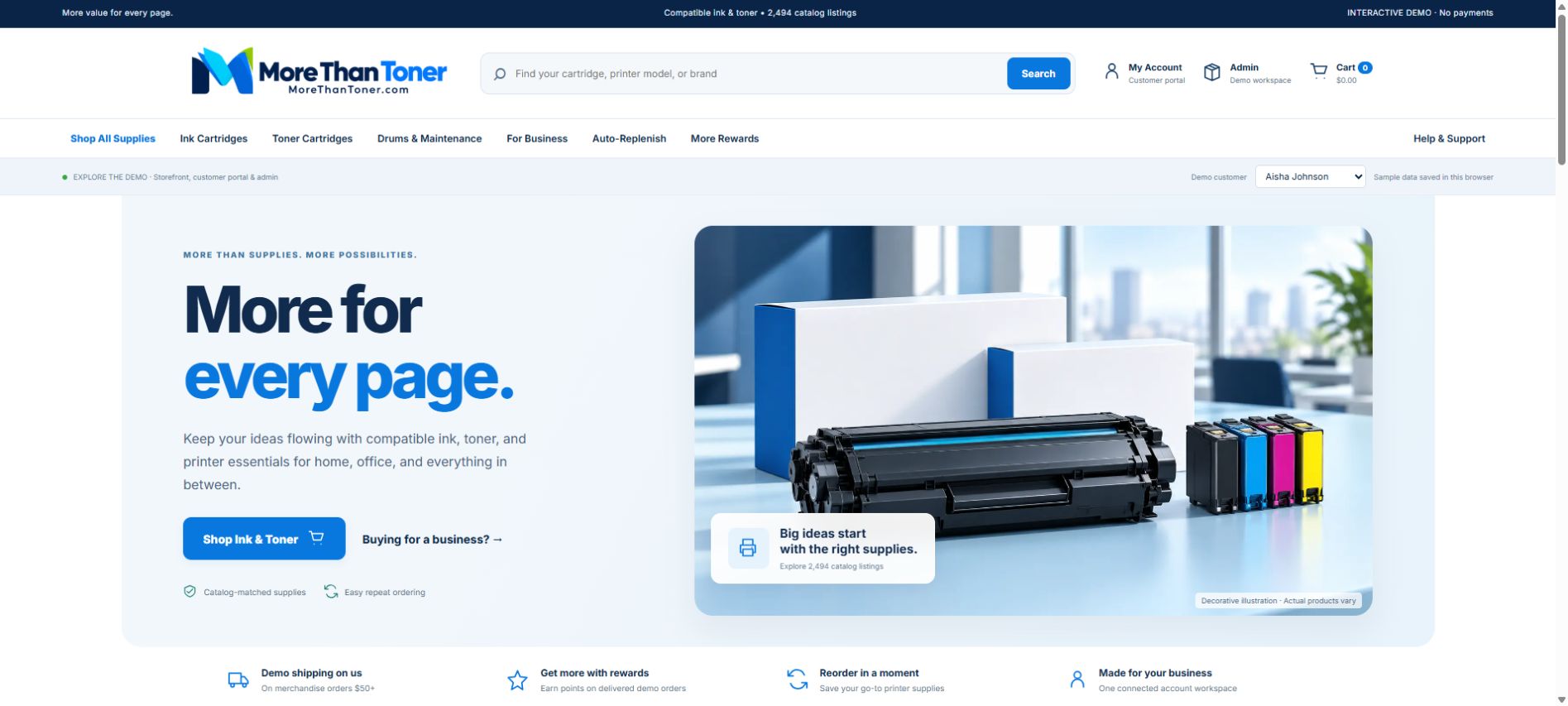
More Than Toner demo storefront with cartridge search and demo account controls
THE PROJECT IN DEPTH · MORE THAN TONER
For a replenishment business, the most important purchase is often the next one. The platform should make repeat buying easier while giving the operator more control over the relationship.
A custom e-commerce demonstration for product discovery, customer ordering and operational administration.
01 / THE CONTEXT
Understanding the business problem
Office supplies commerce is a practical, high-intent environment. Buyers often know what they need, care about compatibility and availability, and do not want to rebuild the same basket every time a printer runs low. A storefront that optimizes only for browsing misses much of the value of the customer relationship.
The More Than Toner project grew from an earlier Inkloop demonstration. The current business identity is More Than Toner, while the available Vercel demonstration still uses the earlier project name. That distinction matters: the case study documents the platform direction without misrepresenting the current production state.
The design opportunity was to connect product discovery, account experience and business administration so the site could evolve beyond a simple catalog.
02 / THE STRATEGY
Four decisions that shaped the experience
01
Prioritize practical product discovery
Catalog organization should help a buyer move quickly from a device or supply need to a relevant product. Clear naming, compatibility information, availability and purchasing terms are more useful here than generic lifestyle merchandising.
02
Treat repeat purchasing as a core workflow
Customer accounts and reorder journeys reduce the steps between a known need and a new order. They also create a natural home for order history, preferred products and business purchasing patterns.
03
Bring operations into the same system
Administrative concepts connect the customer journey to product and order management. A custom platform can be shaped around the company’s actual fulfillment, invoicing and support practices instead of assuming every business uses an identical process.
04
Keep integrations modular
Payment, email, inventory and fulfillment services should be connected deliberately, with ownership of customer records and clear error handling. The demo establishes the product direction; it does not prove all of those production integrations are active.
03 / CUSTOMER & TEAM EXPERIENCE
How the journey is designed to work
A visitor explores products and navigates toward the supplies they need.
An account-oriented experience creates a foundation for returning customers and repeat orders.
The administrative side demonstrates how catalog and customer workflows can connect.
Future integration work can link completed purchases to notifications, service and fulfillment.
Explore the workflow
Browse the catalog, locate a product and follow the storefront’s purchasing journey. Use the case study to review the repeat-order and account workflows.
Responsive storefront and product catalog concept.
Customer account and repeat-order journey design.
Administrative workflows for commerce management.
Integration-ready boundaries for checkout, email and inventory services, subject to implementation and testing.
Project deliverables
Responsive commerce demonstration
Product discovery and catalog experience
Customer portal concept
Repeat-order journeys
Administrative workflow concepts
05 / THE OUTCOME & EVIDENCE
What this project demonstrates
A branded demonstration of how commerce and customer service can be unified without treating the website as an isolated storefront.
How success should be measured
We do not substitute invented percentages for verified business results. The following are the relevant indicators for an evidence-based performance review:
Product search success and product-detail-to-cart engagement.
Repeat-purchase rate and time to reorder after production launch.
Order support contacts, fulfillment accuracy and abandoned-checkout patterns.
Customer acquisition cost and lifetime value when reliable analytics are available.
06 / ROADMAP
From the current platform to measured results
Complete the transition from Inkloop demo identity to approved More Than Toner branding.
Verify checkout, taxes, payment settlement, order emails and inventory behavior with real transactions.
Document measurable business outcomes after a representative operating period.
The commercial idea is simple: a better buying experience should become easier each time the customer returns. This demonstration establishes that foundation without claiming unverified sales results.
REPLACE SUBSCRIPTIONS. SAVE MONEY. TAKE OWNERSHIP.
Let’s map your next platform.
Identify the workflows to replace, the data to migrate, and the capabilities your customers need. Scope, costs and ownership terms are agreed before development.